



Amethyst: February's Birthstone as a Wearable Art Gem
How German Kabirski Works Natural Amethyst in Modern Jewelry Design

Amethyst, a violet-hued gemstone from the quartz family, is prized for its beauty and historic significance. Its vivid purple tones — from pale lilac to deep royal hues — have captivated humanity for centuries. The name “amethyst” comes from the Greek word “amethystos,” meaning “not intoxicated,” as ancient Greeks believed the stone promoted sobriety, clarity, and protection from negative energies.
Geologically, amethyst forms within volcanic rocks and geodes, originating from silica-rich solutions. Its iconic purple color results from irradiation and trace elements like iron. Major deposits are found in Brazil, Zambia, Uruguay, and Russia. Throughout history, amethyst adorned royal regalia and sacred artifacts. Today, it remains beloved in jewelry and spiritual practices, often associated with healing energy, intuition, and calmness.
Amethyst Through the Ages: Beauty, Royalty & Spiritual Power
Amethyst has long symbolized prestige, spirituality, and refined elegance. Its deep color was once considered so precious that it ranked alongside emeralds and rubies in royal collections across the world.
Siberian Amethysts
Some of the most sought-after amethysts historically came from Russia’s Ural Mountains, treasured for their intensely saturated violet color and used in royal jewelry for centuries.
The British Crown Jewels
The Kent Amethyst Parure — a majestic set of necklace, earrings, brooches, and tiara — was created for Queen Victoria’s mother, the Duchess of Kent. It remains one of the most iconic amethyst displays in the Crown Jewels.
The Bishop's Amethyst
A notable historical amethyst once owned by Pope Pius IX is now part of the Smithsonian’s celebrated collections, set into a stunning necklace surrounded by sapphires and diamonds.
Catherine the Great's Amethysts
The Empress of Russia possessed magnificent amethyst jewelry, further elevating the stone’s association with imperial luxury and power during her reign.
Brazilian Amethyst Geodes
Brazil is famous for extraordinary amethyst geodes — massive mineral formations that showcase breathtaking crystal clusters. Many reside in museum halls and elite private collections.
Together, these historical examples reaffirm amethyst’s timeless allure, power, and cultural resonance — a gemstone of protection, presence, and pure mystery.

Amethyst: Exploring Spiritual Beliefs and Healing Attributes
Amethyst has long been admired not only for its beauty but also for its powerful symbolism and metaphysical qualities. Across cultures, it is associated with tranquility, emotional clarity, and spiritual protection — viewed as a gemstone capable of calming the mind and elevating awareness.
One of the oldest legends links amethyst with sobriety. In ancient Greece, it was believed that wearing or holding the stone could prevent intoxication — inspiring its name from the Greek word “amethystos,” meaning “not intoxicated.” During the Middle Ages, this belief continued as people carved goblets and amulets from amethyst to promote clarity and sound judgment.
In spiritual practices, amethyst is often connected to higher consciousness and intuition. It is believed to activate the third eye chakra, assist in meditation, and encourage spiritual growth. Many use it as a source of calm during moments of stress, seeking inner balance and emotional harmony.
Amethyst is also considered a powerful guardian against negativity. It is said to form a protective shield that purifies energy, wards off harmful influences, and supports a peaceful environment — whether worn as jewelry or placed in a space that needs grounding and clarity.
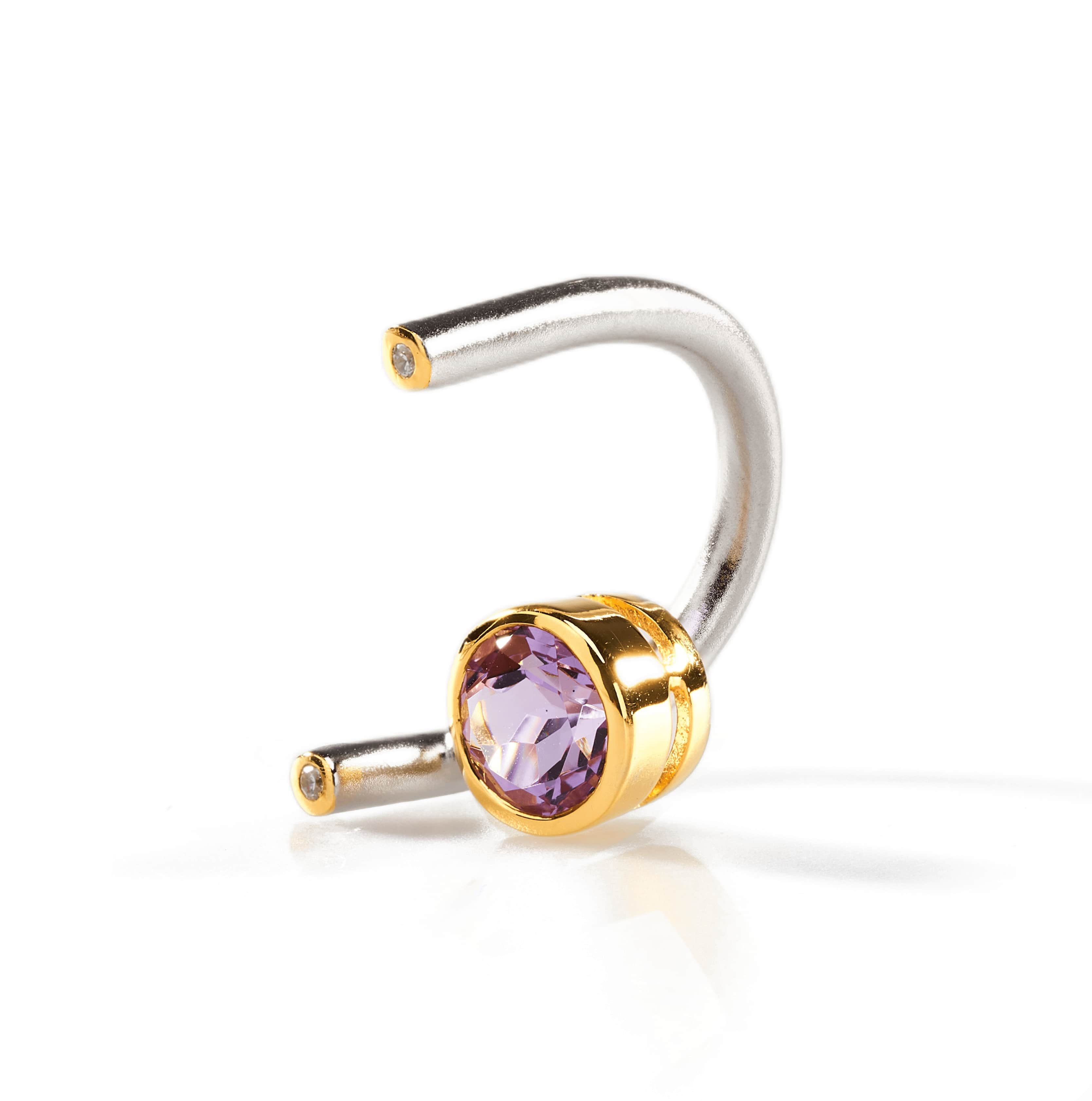
Furthermore, amethyst is considered a stone of healing, both physically and emotionally. It's believed to have the power to alleviate ailments related to the nervous system, headaches, and sleep disorders. Some practitioners also use amethyst for its purported ability to aid in overcoming addictions and breaking unhealthy patterns by promoting clarity of thought and strengthening resolve.
In holistic healing practices like crystal healing and Reiki, amethyst is often utilized for its calming and purifying properties. Practitioners place amethyst crystals on specific parts of the body or incorporate them into healing sessions to restore balance, promote spiritual growth, and enhance overall well-being.
While scientific evidence supporting these mystical properties is limited, the belief in amethyst's metaphysical abilities continues to endure, making it a sought-after gemstone for those seeking spiritual growth, clarity, and emotional balance. Whether worn as jewelry or used in spiritual practices, amethyst remains a symbol of tranquility and inner strength for many individuals.

Amethyst's Celestial Affinity: Connecting Birth and Cosmic Harmony
Ancient civilizations believed that gemstones aligned with astrology, empowering certain zodiac signs. In astrology, amethyst is linked to Pisces (February 19 – March 20), enhancing intuition, creativity, and spiritual awareness while offering emotional protection to those born under this sign.
Amethyst is also associated with Jupiter — the ruling planet of Pisces. This celestial connection is believed to strengthen Piscean qualities and attract prosperity, clarity, and inner growth. Many wear amethyst jewelry as a way to stay connected to these supportive energies.
As the birthstone of February, amethyst is cherished for symbolizing sincerity, peace, and inner strength. People born in this month traditionally wear it for confidence, balanced emotions, and a sense of calm in their daily lives.
Folklore suggests that amethyst brings stability and clarity of thought throughout life’s challenges, harmonizing the wearer with positive energy and shielding from negativity. This enduring link between gemstone and star sign reinforces amethyst’s role as a meaningful companion on one’s personal journey.

Amethyst's Meaning in German Kabirski's Freakaverse
While the mystical beliefs surrounding amethyst continue to inspire imagination, what remains undeniable is its powerful role in German Kabirski’s avant-garde jewelry. Here, amethyst becomes more than a gemstone — it represents defiance, creativity, and the courage to challenge the ordinary.
German Kabirski’s unconventional designs celebrate individuality and fearless self-expression. When amethyst becomes part of these creations, it transforms into a personal talisman — a reminder to resist conformity, stand apart, and explore new dimensions of style and identity.
Within the Freakaverse — Kabirski’s visionary world — amethyst symbolizes rebellion against the predictable. It encourages confidence, inspires originality, and sparks a bold aura that refuses to blend in with the crowd. It’s not simply jewelry; it’s a declaration of who you are.
Amethyst-infused designs speak to free spirits who seek more than adornment — they seek a reflection of their essence. In this universe, amethyst becomes a catalyst for empowerment, urging wearers to celebrate their eccentricities and shine unapologetically. In the Freakaverse, amethyst stands as a beacon of individuality and unapologetic personal power.
Amethyst in Contemporary Jewelry: A Versatile Gem for Creative Expression
In modern jewelry design, amethyst stands out as a versatile gemstone that unlocks a wide range of creative possibilities. With its captivating color palette and expressive character, it gives designers freedom to explore bold ideas and craft pieces suited to many different styles and personalities.
Its adaptability to various cuts, sizes, and settings allows amethyst to shine in both minimalist silhouettes and richly detailed statement pieces. Whether paired with sleek metals or contrasted with other gemstones, it fits seamlessly into contemporary aesthetics while adding a vivid touch of individuality.
From wearable everyday jewelry to avant-garde concepts, amethyst empowers designers to push boundaries and redefine what modern luxury looks like. Its timeless elegance combined with artistic flexibility ensures amethyst remains a favorite for creators and collectors who appreciate jewelry that feels both current and enduring.

German Kabirski's Raw Amethyst: Embracing Nature’s Imperfect Beauty
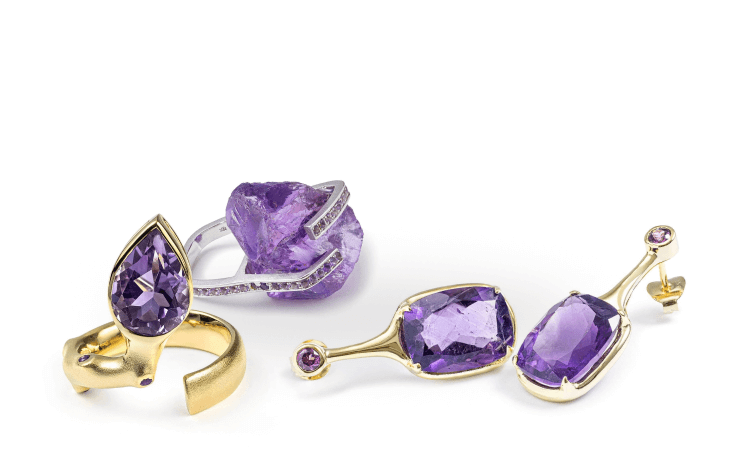
In German Kabirski’s avant-garde jewelry, raw amethyst crystals become the centerpiece of expression. While traditional jewelers favor refined and polished stones, Kabirski chooses to reveal amethyst in its untouched, natural state — preserving its original character, energy, and wild charm.
This creative approach honors the unprocessed beauty of the gemstone. Each crystal retains its authentic structure, inclusions, and uneven facets — details that reflect its true geological journey. For Kabirski, imperfection is not a flaw but a signature of real beauty.
Raw amethyst pieces in his collections radiate a distinct vibrancy. Their textures and irregular forms amplify the stone’s presence, offering a connection to nature’s unfiltered power. The result is jewelry that feels alive — expressive, bold, and emotionally charged.
Kabirski’s philosophy rejects the pursuit of flawless symmetry. Instead, he celebrates uniqueness: the cracks, the shadows, the unexpected. Each raw amethyst becomes a one-of-a-kind sculpture that commands attention and invites curiosity.
These creations are more than adornments. They are wearable artworks that challenge conventional jewelry norms — empowering individuals to embrace their own individuality and the beauty found in authenticity.
Conclusion: Amethyst Myths and Kabirski’s Unorthodox Stance
Amethyst has always been a gemstone surrounded by myth, symbolism, and fascination — from ancient Greek legends to its enduring reputation as a stone of clarity and spiritual strength. It carries stories from the past while continuing to intrigue the modern world.
German Kabirski takes this storied gemstone into a new chapter. Rejecting the polished perfection favored by mainstream jewelry, he embraces raw amethyst — rugged, uncut, and true to its natural essence. Each crystal becomes a sculptural fragment of the Earth, retaining its personality and wild spirit.
Rather than correcting what makes the stone unique, Kabirski highlights the irregularities. The cracks, the textures, the unexpected forms — all become part of a narrative that celebrates individuality instead of uniformity. These creations hold the intrigue of ancient lore while standing firm as symbols of bold self-expression.
In Kabirski’s hands, amethyst is not a gem refined into silence — it is a voice. A statement of character, a rejection of conformity, and an embrace of the beautifully imperfect. This is jewelry that invites curiosity and empowers the wearer to celebrate what sets them apart.
Rooted in mythology yet revolutionized through avant-garde design, amethyst remains a gemstone of mystery, transformation, and unapologetic identity. A perfect reflection of the Freakaverse — where raw beauty leads the way.
Share your comment
This site is protected by hCaptcha and the hCaptcha Privacy Policy and Terms of Service apply.